From brochure site to patient decision system.
Dentists @ Canning Vale had an established practice and a website that no longer reflected the depth of its team, treatments or local relevance. The rebuild turns that thin digital footprint into a structured route from search question to informed appointment.
- Client
- Dentists @ Canning Vale
- Market
- Canning Vale, Western Australia
- Scope
- Strategy, UX, content architecture, SEO and launch governance
- Status
- Staging build · outcomes not yet measured
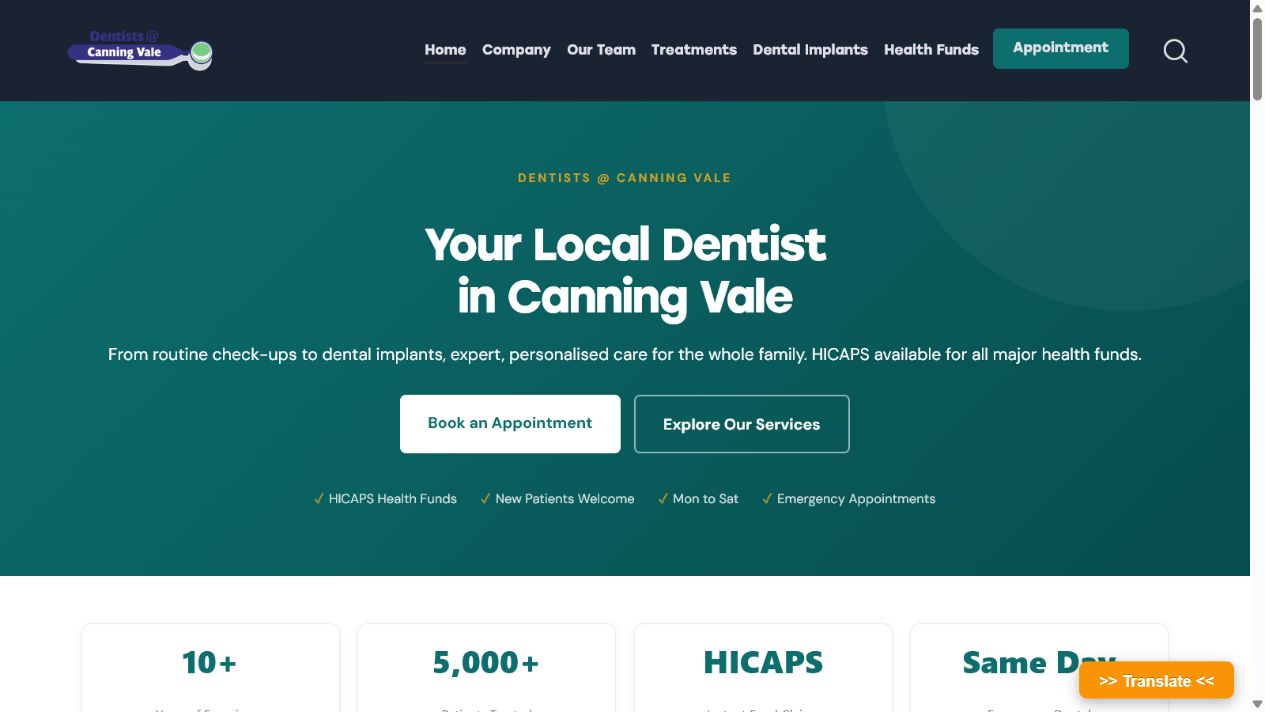
Observable staging changes—not traffic, ranking or patient-acquisition claims.
01 · The brief
The practice had more to say than the website could carry.
Create a modern dental website that is easier for patients to navigate, stronger for local search and safer to govern before launch.
The old website functions as a compact online brochure: practice details, a booking path and a general summary of services. But treatment discovery is shallow, practitioner information is separated from patient questions, and key search signals are missing from the homepage.
The rebuild is designed around three jobs: help local patients understand what the practice offers, help search systems understand page purpose and relationships, and give the practice a more controlled publishing structure.
02 · Visual comparison
Same practice. A much clearer first impression.
These screenshots show website interfaces—not dental treatment outcomes. Captured 23 July 2026 at the same desktop viewport.
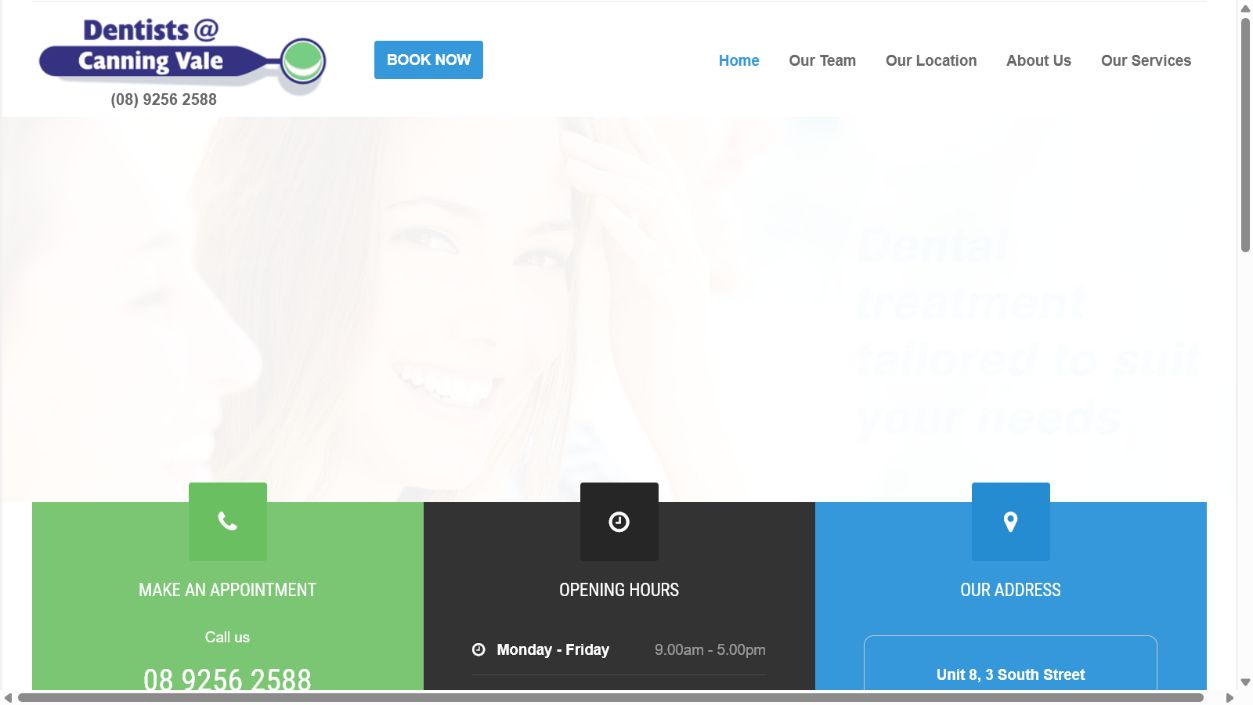
- No clear homepage H1 detected
- Image-led opening with little decision support
- Practice information competes across three large panels
- Limited treatment and practitioner pathways
- Location-led H1 and explanatory opening
- Primary appointment and service actions
- Visible health-fund, availability and emergency cues
- Navigation organised around patient decisions
03 · What changed
The redesign is structural, not cosmetic.
A local-search homepage
The page title and H1 now establish the practice, service category and Canning Vale location immediately, while the visible copy supports rather than repeats that intent.
Patient-led navigation
Patients can move directly into treatments, dental implants, health funds, practitioner information or appointment booking instead of interpreting a small set of generic menu labels.
Deeper treatment architecture
Dedicated service URLs create room for suitability, process, risks, alternatives, cost context and next steps—subject to clinical and advertising review before publication.
Visible practitioner accountability
Individual team pages connect qualifications and professional identity to the people responsible for care, without relying on inflated expertise language.
Conversion without pressure
Appointment actions are prominent, but the journey also gives visitors service information, health-fund context and common questions before asking them to book.
A governed launch
The migration plan covers redirects, indexation, sitemap pruning, canonical checks, analytics and a final review of claims, testimonials, titles and substantiation.
04 · Evidence
What we can prove before launch.
The comparison below is based on rendered homepage HTML and the public XML sitemaps reviewed on 23 July 2026.
05 · Information architecture
One homepage now opens into multiple useful journeys.
Emergency dentistry
Availability, what to do next and how to contact the practice.
Service information
Purpose, suitability, process, limitations and appointment pathway.
Practitioner pages
Qualifications, professional identity and practice accountability.
Health funds & pricing
HICAPS, provider context, eligibility limits and likely next questions.
06 · Before it goes live
A strong redesign still needs a disciplined launch.
- Map valuable old URLs to their closest new equivalent
- Remove staging blocks only after launch QA
- Publish only canonical, indexable URLs in the final sitemap
- Exclude template portfolio, archive and unused taxonomy URLs
- Validate analytics, form events and booking hand-offs
- Substantiate experience and patient-volume figures
- Review “expert”, “same day” and outcome-adjacent wording
- Remove or control clinical testimonials and testimonial feeds
- Verify practitioner titles, registrations and qualifications
- Clinically review treatment copy, imagery, risks and limitations
Important: this case study assesses marketing and publishing risk, not legal compliance. Final advertising should be approved by the practice and reviewed by qualified legal, regulatory or clinical advisers where appropriate.
07 · Measurement plan
The honest result is: not yet.
The replacement site is still on staging. Publishing percentage improvements now would be theatre, not evidence. The case study will be updated after launch when comparable data has accumulated.
Local and treatment queries
Non-brand impressions, clicks, average position and landing-page coverage.
Qualified engagement
Service-page progression, practitioner-page visits and useful internal journeys.
Appointment intent
Tracked calls, booking hand-offs and forms—with spam and duplicate activity removed.
Technical stability
Index coverage, redirect errors, Core Web Vitals and crawlable canonical URLs.
Method and sources
Evidence before adjectives.
Observations were taken from the rendered public and staging homepages and their XML sitemaps on 23 July 2026. Staging content can change before launch. The review used current primary guidance as a risk and implementation framework.
Ahpra advertising guidelines ↗ACCC false or misleading claims guidance ↗Google LocalBusiness structured data documentation ↗Your before-and-after starts here
Make the next version
measurably better.
We can audit the current website, preserve what matters and build the migration around patients, search and responsible publishing.